San Marcos houses mostly date 1984 to 2014, and that stock plus our mild, sometimes-freezing climate shapes when garage door repairs actually matter here.
Most houses in San Marcos went up between 1984 and 2014, with the bulk of that stock dating to the 1980s and 90s across the area's sixteen named neighborhoods and hamlets. That matters because a lot of original torsion springs, openers, and rollers installed when those houses were framed are now thirty to forty years old on the early end. If your door groans on the way up, hesitates halfway, or the opener runs longer than it used to before the door moves, that's wear talking, not a fluke.
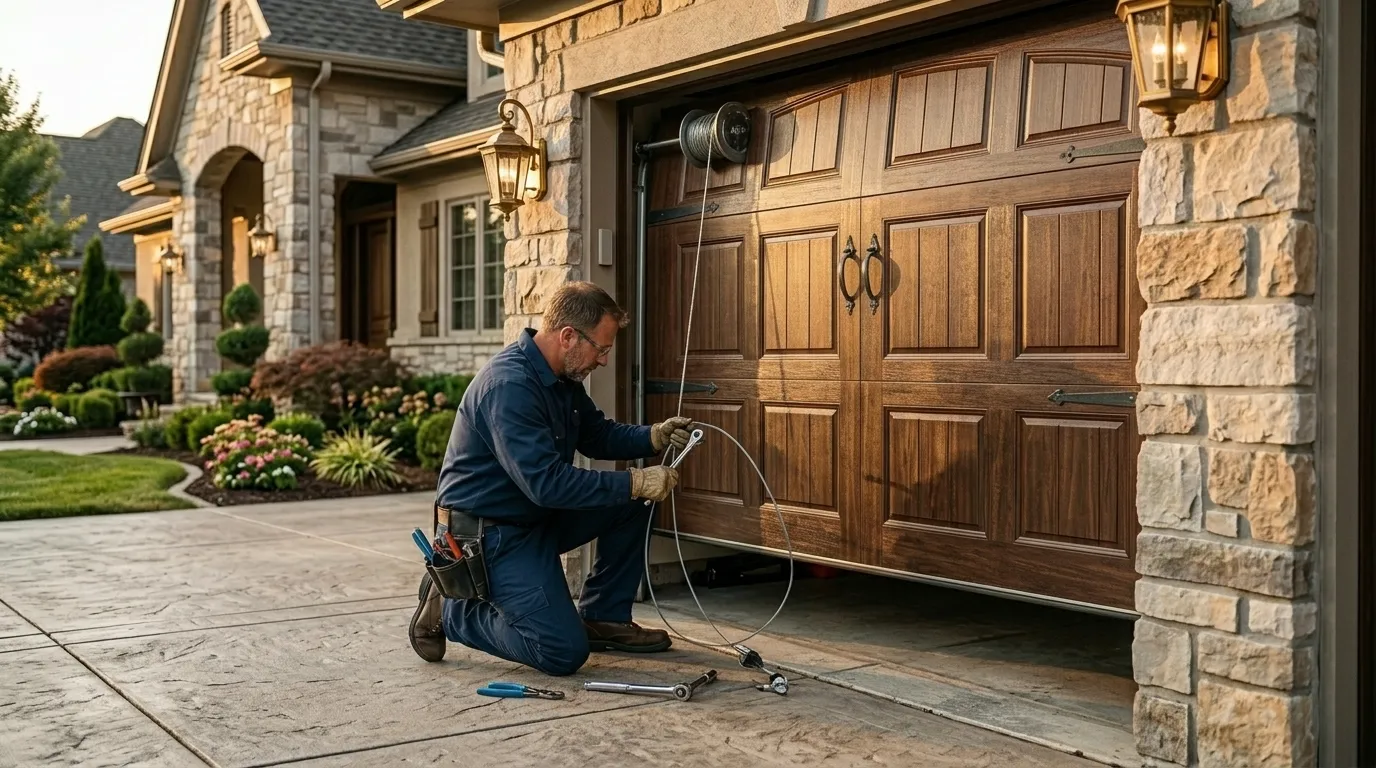
Get someone out the same day if a cable has frayed or a spring has snapped - both ends of a broken torsion spring plus a door that won't stay up are not a wait-and-see situation, especially with a car trapped inside. Slower issues - a track that's slightly bent, a roller that squeals, an opener that's noisy but still working - can wait a week or two for a scheduled visit. Don't wait on a door that reverses on its own or drops without warning; that's a safety sensor or spring balance problem, and it's the kind of thing that hurts someone eventually if it's ignored.
What It Costs
We don't have a posted price list here, and giving you a number without seeing the door would be a guess dressed up as an answer. What we can tell you is what drives the cost up or down. A door on a house built in the late 1980s or early 90s often needs parts that aren't a straight swap for what's sold today - track widths, spring wind, and drum sizes shifted over those three decades, so a repair on an older unit sometimes means sourcing a specific part rather than grabbing something off the shelf.
Newer doors, closer to the 2014 end of that 1984-2014 build range, usually take standard parts and go faster. The other cost factor is what you're fixing: a spring or cable job is a parts-and-labor visit measured in an hour or two, while a full door or opener replacement is a bigger job with more moving pieces. If a door needs more than two or three separate repairs to get back to reliable, replacement usually costs less over the next few years than another round of patches - that's the honest tradeoff, and we'll tell you straight which side of that line your door is on.
The Problem
The core issue in San Marcos is that a huge share of the housing stock crossed into its third or fourth decade at roughly the same time. Doors, springs, and openers don't fail on a schedule, but they cluster - a neighborhood built in one construction wave tends to need garage door work in waves too. We see this across the sixteen named areas in the service footprint, from the closer-in ones to the ones out toward Wimberley and Canyon Lake.
The other piece is that garage doors are the largest moving object in most of these houses, and they're also the most neglected. A furnace gets serviced. A water heater gets flushed. A garage door usually gets nothing until it stops working, and by then the spring has been carrying an imbalanced load for months, which wears the opener gears faster and stresses the tracks. None of this is unique to any one house - it's just what happens to hardware installed in the 80s, 90s, and 2000s that's now doing daily work it was never checked on.
How Local Conditions Play In
San Marcos sits in a mild climate band with only occasional freezes, not the hard freeze-thaw cycling that snaps springs and swells wood doors up north. That's good news for the metal - torsion springs here don't see the repeated contraction that shortens their life elsewhere. The tradeoff is that with fewer forced maintenance moments (no one's out there scraping ice off a track), problems get ignored longer, because nothing ever forces the issue the way a hard winter would.
Across the 54,708 households we cover, 31,977 are owner-occupied houses - the kind with an actual garage door to maintain, as opposed to rentals where a landlord decides when repairs happen. With a median household income of $80,830 in this area, most owners here can afford a full opener swap rather than nursing a fifteen-year-old unit along, and we'd rather tell you that plainly than talk you into another patch job. San Marcos also sits close enough to Redwood (5 miles), Martindale (6 miles), and Kyle (9 miles) that a lot of our calls come from homeowners who moved out from those closer-in areas and brought the same era of house with them.
How it works
From “it’s stuck” to “it’s fixed”
01
Tell us what’s wrong
Describe the symptom - won’t open, loud bang, opener runs but the door won’t move.
02
On-site diagnosis
A technician tests the door under power and by hand and finds what actually failed.
03
Clear, up-front plan
You get the fix that’s needed and what drives the cost - before any work starts.
04
Repaired & tested
The repair is done, the door is set true and tested, and the work area left clean.
Serving San Marcos, TX - tell us what your door’s doing and we’ll take it from there.
Why does my opener from the 90s sound different than a new one?
Openers installed when a lot of San Marcos houses were built in the 1980s and 90s used chain drives and older motor designs that run louder by nature, not because they're broken. If yours has gotten noticeably louder over time, though, that's usually a gear or chain tension issue worth checking, separate from the age-related hum.
Does the mild climate here mean I can skip maintenance?
No. San Marcos avoids the hard freeze-thaw cycles that crack springs elsewhere, but that just means the failure mode here is slow wear and neglect instead of cold-weather stress. A door still needs its rollers and hinges checked every so often regardless of climate band.
Is it worth replacing a door versus repairing it?
If your door needs more than two or three separate fixes to work reliably, replacement usually costs less over the next few years than repeated patch repairs. Given the median income across this area, most owners choose replacement once a door hits that point rather than keep repairing an aging unit.
Ready to get your garage door sorted?
Tell us what it’s doing and where you are in San Marcos - we’ll take it from there.